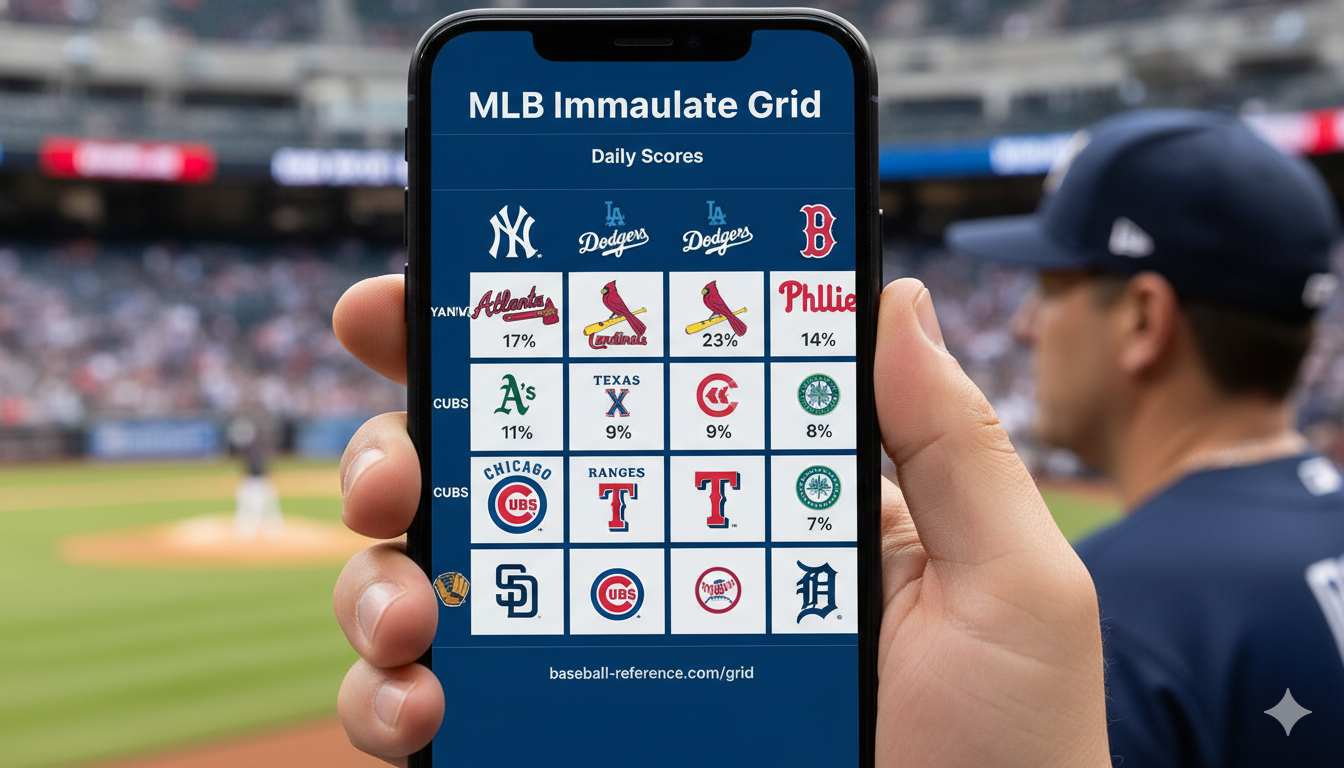
If you have spent any time on sports social media over the last few years, you’ve likely seen a 3×3 box filled with logos and percentages. This is the MLB Immaculate Grid, a daily ritual that has transformed how fans interact with baseball history. Launched in early 2023 and later acquired by Sports Reference, this game isn’t just about knowing who played for the Yankees or the Dodgers; it’s a deep dive into the obscure corners of Baseball-Reference. It challenges your memory of “journeymen” players—those utility guys who seemed to suit up for a new team every season.
The beauty of the MLB Immaculate Grid is its simplicity. You have nine squares and nine guesses. To achieve an “immaculate” result, every single guess must be correct. One wrong answer, and your grid is broken. It’s the ultimate “coffee and baseball” companion for fans who want to test their knowledge before the first pitch of the day. Whether you are a casual viewer or a “stat-head,” the grid offers a satisfying way to prove your diamond expertise.
How to Play the MLB Immaculate Grid
The rules of the MLB Immaculate Grid are straightforward but punishing. You are presented with a grid where the rows and columns represent different criteria. These criteria could be specific teams (e.g., “Played for the Braves”) or statistical milestones (e.g., “300+ Career Wins” or “Silver Slugger Winner”). Your job is to find a player who fits the intersection of both the row and the column.
The catch? You only get nine guesses. If you guess a player who played for the Braves but never won a Silver Slugger in a square requiring both, that square remains empty, and you lose one of your precious nine attempts. This high-stakes environment is what makes the game so addictive. You have to be certain before you click, or your dreams of an immaculate day are over.
Mastering the Rarity Score
For many veterans, just finishing the grid isn’t enough. The real “game within the game” is the rarity score. When you enter a player’s name, the MLB Immaculate Grid calculates what percentage of other players chose that same person. For example, if you use Greg Maddux for a Braves/Cubs square, your rarity score might be high (say, 45%) because he is an obvious choice. However, if you remember a backup catcher like Henry Blanco, your score for that square might be a tiny 0.2%.
The goal is to have the lowest total rarity score possible—think of it like golf. To excel, you need to move away from Hall of Famers and look for “Grid Gods.” These are players like Jesse Chavez, Edwin Jackson, or Octavio Dotel, who played for so many teams that they can fit into almost any crossover. Lowering your rarity score is the ultimate bragging right in the baseball trivia community.
Where to Find MLB Immaculate Grid Answers Today
Let’s be honest: sometimes we all get stuck. Maybe you can’t remember a single player who suited up for both the Seattle Mariners and the Florida Marlins in the late 90s. Searching for MLB Immaculate Grid answers today is a common way for fans to learn more after they’ve exhausted their own memory. Many dedicated blogs and Twitter accounts post the daily solutions and “rarity sleepers” to help you finish your grid.
However, the best way to find MLB Immaculate Grid answers today—without technically cheating—is to use the “Possible Solutions” link provided by Baseball-Reference after you finish your game. It’s a fantastic educational tool. Looking at the full list of qualifying players often leads to those “Oh, I totally forgot he played there!” moments, which helps build your mental database for tomorrow’s grid.
The Dream of MLB Immaculate Grid Unlimited
The only downside to the standard game is that there is only one new grid every 24 hours. This led to the demand for MLB Immaculate Grid unlimited options. While the official site primarily focuses on the daily puzzle to keep the community synchronized, they have introduced an “Archive” feature. This allows users to go back and play every single grid ever created, effectively giving you MLB Immaculate Grid unlimited access to hundreds of past challenges.
For those who still want more, several third-party “grid” style games have popped up, but few can match the data accuracy of the original. Playing through the archives is the best way to practice. It helps you recognize patterns in the criteria and forces you to dig deeper into different eras of baseball history. If you are stuck on a long flight or a train ride, the archive is your best friend.
Why “Grid Gods” are Your Secret Weapon
To truly dominate the MLB Immaculate Grid, you must study the “journeymen.” These are the players who weren’t necessarily superstars but were valuable enough to stay in the league for 15+ years across 10+ different franchises. Names like Rich Hill, Matt Latos, and Fernando Rodney are essential to your “grid vocabulary.”
I remember one specific grid where the criteria were “Twins/Athletics” and “Twins/Rays.” I initially thought of big names, but using a middle reliever who played for those teams in the mid-2000s gave me a rarity score under 1%. These “Grid Gods” are the difference between a total score of 150 and a total score of 15. Keep a running list of these players in your head; they are the keys to the kingdom.
Statistical Milestones: The Hardest Squares
The toughest squares in the MLB Immaculate Grid usually involve statistical milestones. While team crossovers rely on memory, milestones like “.300 Career Batting Average” or “30+ Stolen Bases in a Season” require precision. You might remember a player being fast, but did they actually hit the 30-SB mark with that specific team?
One tip is to look for players who had one random “career year.” Many fans forget that certain power hitters once had a high-average season early in their careers. Also, be careful with pitching stats like “200+ Strikeouts in a Season.” Modern pitchers reach this less frequently than those from the 1970s or 80s, so digging into older eras can often lead to a much lower rarity score.
The Social Aspect: Sharing Your Grid
The MLB Immaculate Grid became a viral sensation because of its “share” feature. Like Wordle before it, the grid allows you to post your results as a text-based graphic that shows your success without spoiling the names. This created a daily conversation among friends and coworkers.
Sharing your grid isn’t just about showing off; it’s about the debate. “How did you possibly remember that guy played for the Brewers?” is a common refrain in many baseball group chats. It has turned a solitary trivia game into a communal event, bringing fans together to celebrate (and occasionally lament) the weird and wonderful history of Major League Baseball.
Using the Baseball-Reference Integration
Since Sports Reference acquired the game, the integration has been a “people-first” success story. Each square is now linked directly to the Baseball-Reference database. If you are ever curious about why a certain player qualified, you can click through to their career stats instantly.
This level of authority and trustworthiness is why the MLB Immaculate Grid stays at the top of the pile. You aren’t just guessing; you are interacting with the most accurate sports data on the planet. For me, the most helpful part of the integration is the “Rarity Leaderboard” that appears after the game, showing you the most “efficient” players used by the community that day.
Tips for Beginners: Don’t Panic!
If you are new to the MLB Immaculate Grid, the most important advice is to take your time. There is no timer. If a square has you stumped, walk away and come back later. Sometimes a name will pop into your head while you are doing something completely unrelated.
Also, don’t be afraid of a high rarity score at first. Your first goal should be to just get nine out of nine correct. Once you are comfortable finishing the grid, then you can start challenging yourself to find more obscure players. Baseball history is massive—covering over 150 years—so there is always something new to learn.
Conclusion:
The MLB Immaculate Grid is more than just a passing fad; it’s a staple of the modern baseball fan’s lifestyle. It bridges the gap between generations, forcing us to remember the stars of the 1920s alongside the rookies of 2026. Whether you are searching for MLB Immaculate Grid answers today or grinding through the MLB Immaculate Grid unlimited archives, you are participating in a global celebration of the game’s complexity.
So, are you ready to test your luck? Head over to the grid, think of your favorite utility infielder from the 90s, and see if you can achieve that elusive rarity score of under 10. We’ll see you on the leaderboard!
FAQs
1. How many guesses do I get in the MLB Immaculate Grid?
You get exactly nine guesses to fill nine squares. Every guess, whether right or wrong, counts as one of your nine attempts.
2. Can I use the same player twice in one grid?
No. Once a player is used in a square, they cannot be used again for any other square in that day’s grid, even if they fit the criteria.
3. Does the player have to have played a game for the team?
Yes. To qualify for a team square, the player must have appeared in at least one major league game for that franchise. Being in their minor league system or on the spring training roster does not count.
4. What is a “good” rarity score in the MLB Immaculate Grid?
While “good” is subjective, most competitive players aim for a total rarity score under 50. Elite “rarity hunters” often try to stay under 10.
5. Is there a mobile app for the MLB Immaculate Grid?
As of now, the game is primarily played through the official website on mobile or desktop browsers, though it is fully optimized for mobile play.
About the Author